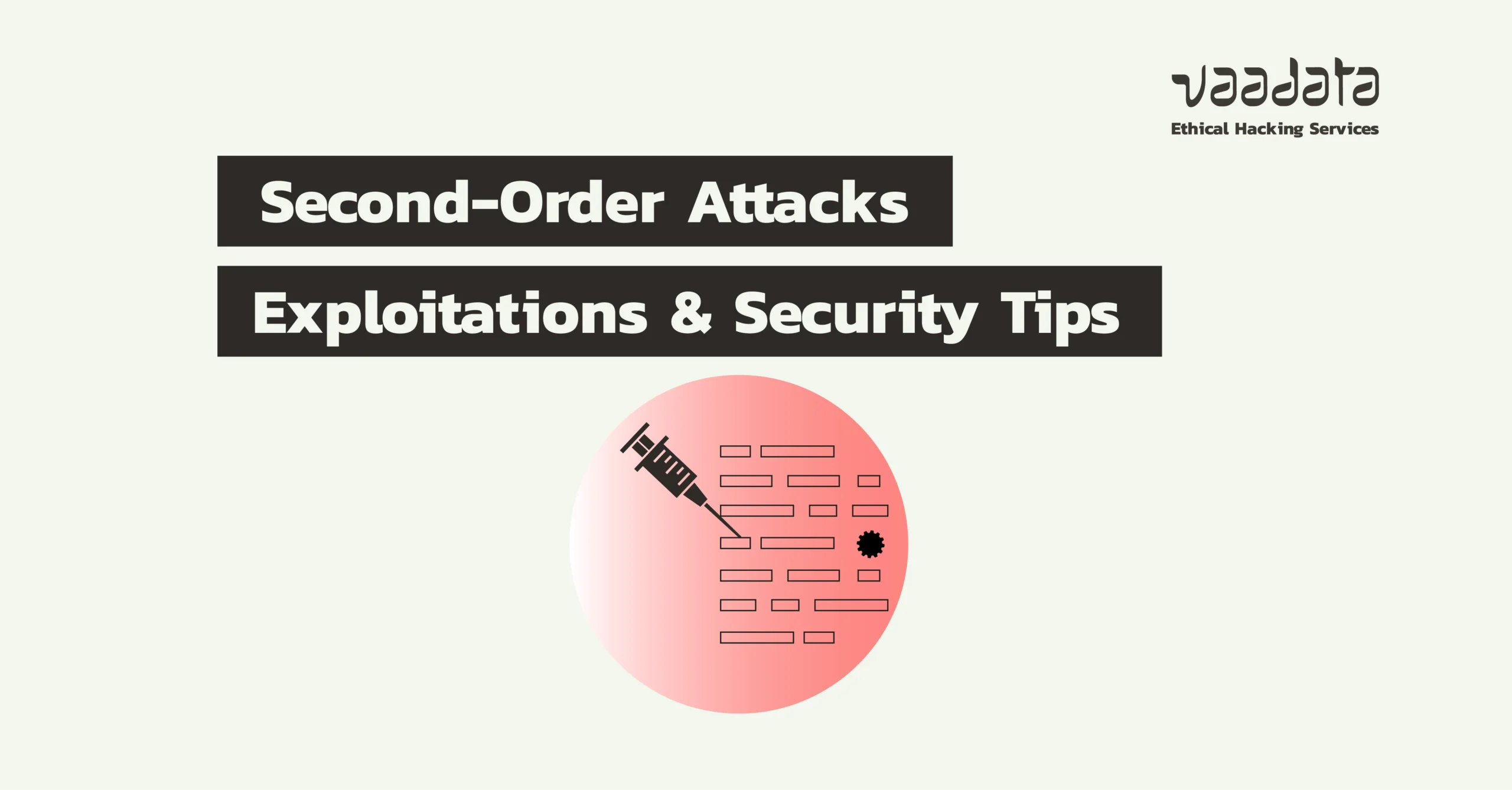
Second-Order Attacks, Exploitations and Security Best Practices
What is a Second-Order Attack? Second-order vulnerabilities are not a distinct type of vulnerability in their own right, as a command injection might ...

A cloud penetration test assesses the security of your cloud infrastructure. Testing can cover AWS, Microsoft Azure or Google Cloud Platform (GCP) environments, as well as their managed services, including instances, storage, databases, serverless functions and Kubernetes clusters.
The assessment focuses on identifying configuration errors, excessive permissions and misconfigured or overly permissive roles, as well as the unintended exposure of services such as APIs, administration consoles or public storage.
At the end of the assessment, you will receive a clear, prioritised report detailing the vulnerabilities identified, exploitation scenarios and their impact on the overall security of your cloud environment. Tailored recommendations help you strengthen your security posture over time. Our auditors can also perform a retesting phase to confirm the effectiveness of the fixes implemented.

Our auditors perform cloud penetration tests in highly complex environments, whether on AWS, Azure or GCP. Our approach adapts to your architectural choices, whether it's a full cloud deployment, a hybrid environment or an interconnection with an on-premise information system.



A cloud penetration test can be carried out using three complementary approaches, each offering a different perspective on the security of your infrastructure.
The black box replicates the perspective of an external attacker with no prior knowledge of the target cloud environment.
The grey box provides auditors with partial access (limited privileges, a developer account, or a restricted scope) in order to simulate a real initial compromise.
The white box provides full access to documentation, configurations, infrastructure as code, and sometimes application code or CI/CD pipelines.
Our auditors identify and inventory accessible accounts, subscriptions and projects; deployed services (virtual machines, databases, serverless functions, storage buckets, Kubernetes clusters); and public endpoints (APIs, web interfaces, network entry points). This phase also includes analysing IAM permissions and roles, as well as performing passive reconnaissance for exposed information to define the attack surface and prioritise the vectors to be tested.
Our auditors conduct a detailed analysis of configurations to detect misconfigurations and excessive permissions. They examine IAM permissions and associated policies, verify network configurations, assess storage rules and review serverless function settings.
Our auditors identify technical vulnerabilities and misconfigurations specific to cloud environments. This includes detecting publicly exposed or unauthenticated resources, searching for exposed API keys, tokens or secrets, and analysing serverless services for application vulnerabilities.
Our auditors simulate controlled attack scenarios. These include attempts to escalate privileges via IAM weaknesses or misconfigured services, compromising workloads, extracting sensitive data from cloud storage and pivoting to other connected resources or environments.
Following the assessment, our auditors document the identified vulnerabilities and misconfigurations in a detailed report. Each vulnerability is described with its severity level, exploitation scenario and supporting technical evidence. The report also includes remediation recommendations. We organise a debriefing session to present the findings, walk through the attack scenarios and support your teams in implementing corrective measures.

Choosing Vaadata for a cloud penetration test means working with a CREST, PASSI and ISO 27001 certified company, ensuring quality, rigour and compliance with international cybersecurity and data protection standards. These certifications demonstrate our commitment to industry best practices and the highest standards in every engagement.
Our auditors are experts in complex cloud environments. Their expertise enables them to accurately identify, exploit and document vulnerabilities specific to managed services, virtualised environments and Kubernetes platforms.
Our cloud pentest methodology is based on proven frameworks and covers a wide range of risks. Depending on your objectives, we adapt the scope to focus on the most critical resources.