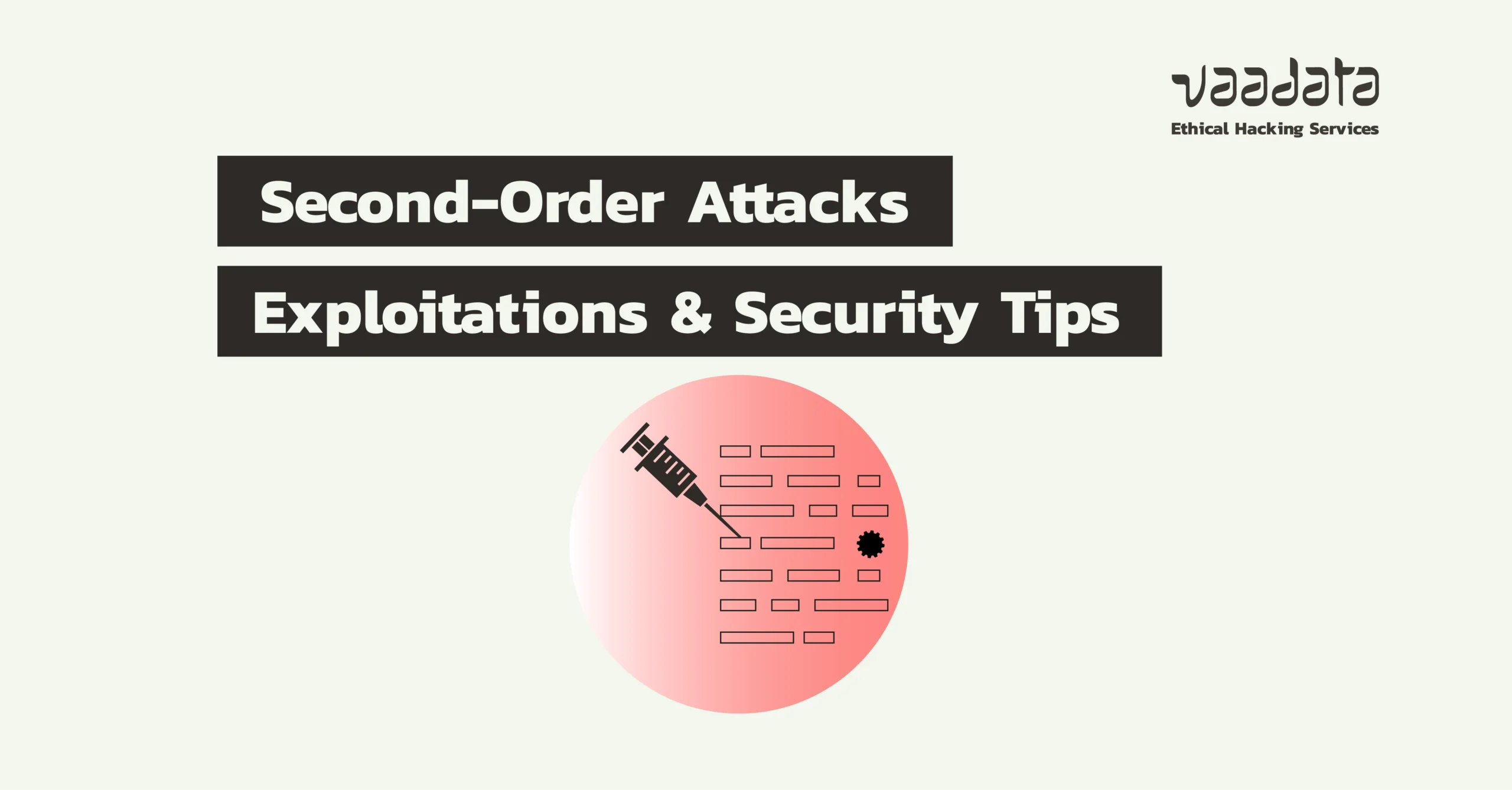
Second-Order Attacks, Exploitations and Security Best Practices
What is a Second-Order Attack? Second-order vulnerabilities are not a distinct type of vulnerability in their own right, as a command injection might ...

An LLM penetration test involves analysing the security of an application that incorporates language models (LLMs), autonomous agents or generative AI pipelines, by simulating targeted attacks. Our auditors analyse not only vulnerabilities specific to the models themselves but also application flaws, third-party integrations (APIs, RAG, MCP servers) and the security configuration of the AI environment. The hosting infrastructure is also included within the scope of the analysis, whether it is based on a cloud-based model provider, a self-hosted model or a hybrid architecture.
At the end of the testing phase, our auditors provide a detailed report. This report includes a description of the vulnerabilities identified, exploitation scenarios and recommendations for remediation. A revalidation phase can then be carried out to verify that the fixes have been implemented correctly and thus ensure the security of your AI system.

Our auditors carry out penetration tests on AI systems built using all types of models, frameworks and architectures — proprietary models (OpenAI, Anthropic, Google) or open-source models, RAG applications, autonomous agents, multi-agent systems and business co-pilots. Whether it’s an internal chatbot, a customer assistant, a development co-pilot or an agent orchestration platform, we tailor our approach to your technical stack and your use case.



An LLM penetration test can be carried out using three approaches, each offering a unique perspective on the security of your AI system.
Our auditors adopt the perspective of an external attacker, with no prior knowledge of the application, model or exposed tools.
Our auditors have access to partial information: user accounts, functional documentation, a description of the model’s capabilities, and an inventory of MCP tools.
Our auditors assess the security of your system with full access: system prompts, source code, model configuration, exposed tools and RAG datasets.
Our auditors map your AI attack surface by identifying the models in use, exposed tools and functions, agents, RAG sources and MCP servers. They also look for leaks of sensitive information (disclosed system prompts, exposed API keys, accessible training data).
The analysis draws on industry benchmark frameworks: OWASP LLM Top 10, OWASP Top 10 for Agentic Applications, MITRE ATLAS, NIST AI RMF and PortSwigger Web LLM Attacks. This stage enables us to identify attack scenarios relevant to your use case.
Our auditors detect and validate vulnerabilities through in-depth manual testing, supplemented by specialised tools. Each vulnerability is analysed according to its severity and its actual impact on your application and business.
The identified vulnerabilities are exploited in a controlled manner to measure their actual impact — data exfiltration, model sabotage, tool abuse, uncontrolled costs — and to identify any potential attack chains involving multiple components.
A detailed report sets out the vulnerabilities identified, their severity level, proof-of-concept exploits and prioritised remediation recommendations. A debriefing with your AI and development teams allows us to explain the findings and support the remediation process, followed by a follow-up audit to validate the effectiveness of the measures implemented.

Carrying out an LLM penetration test with Vaadata means choosing a company certified to the industry’s most stringent standards.
Our company is PASSI, CREST and ISO 27001 certified, which attests to the quality of our services and our compliance with international standards for cybersecurity and personal data protection. These certifications bolster our clients’ confidence by guaranteeing a high standard of methodological and organisational rigour.
Our LLM penetration tests are carried out by certified auditors who are proficient in both traditional application attack techniques and the specific characteristics of language models, agents and the Model Context Protocol. This dual expertise (AppSec and offensive AI) enables them to accurately identify, exploit and document the vulnerabilities specific to each AI environment.